Your split ends have been trying to tell you 7 things. Most women only hear one.
Everyone knows what a split end means. Time for a trim. That is true, and it is also the least useful thing they are telling you.


You know the move.
You grab a section, run two fingers up it, and the ends fan out sideways like a tiny frayed rope. Then you sigh, and you book the trim.
That is the one thing almost every woman hears from her split ends. And it is not wrong. It is just the smallest part of the message.
Because a split end is not only a sign that the tip of your hair is worn out. It is a status report on the entire strand, written months before you ever noticed it. And it is telling you something specific about the length you have been trying to grow for the last three years.
There are seven of these signals. Most women only ever act on the first one.
Here is the rest of what your hair has been saying.
Your ends are see-through, and your roots are not
Hold your ponytail up against a window.
If the elastic end looks thick and the tip looks wispy, you have probably been told at some point that your hair is "just fine at the bottom." It is an easy thing to believe. Most women accept it and never think about it again.
But hair does not taper on its own. Every strand on your head left the same kind of follicle at roughly the same thickness. The reason the bottom looks see-through is not that your hair is fine down there.
It is that most of your strands never made it that far.
What you are looking at when you hold your ponytail to the light is not thin hair. It is the survivors.

They come back three weeks after a trim
You paid for the trim. You watched two inches hit the floor. And by the end of the month, they were back.
The usual conclusion is that the stylist did not take enough off. Sometimes that is true. Usually it is not.
Here is the part nobody explains at the chair: cutting off a split does not fix the strand it was on. The weakness was already there, further up, in a section of hair that has not reached the end of your length yet. You removed the symptom. The strand carried on being the strand it always was, and it split again a little higher.
Which is why some women feel like they are on a treadmill. Grow it, trim it, grow it, trim it, and somehow never end up any longer than they were two years ago.
A split does not begin at the tip. It begins somewhere in the middle, where the strand was built thin, and travels outward until it reaches the end and finally becomes visible to you.
Which means by the time you can see a split end, that strand has been failing for months.

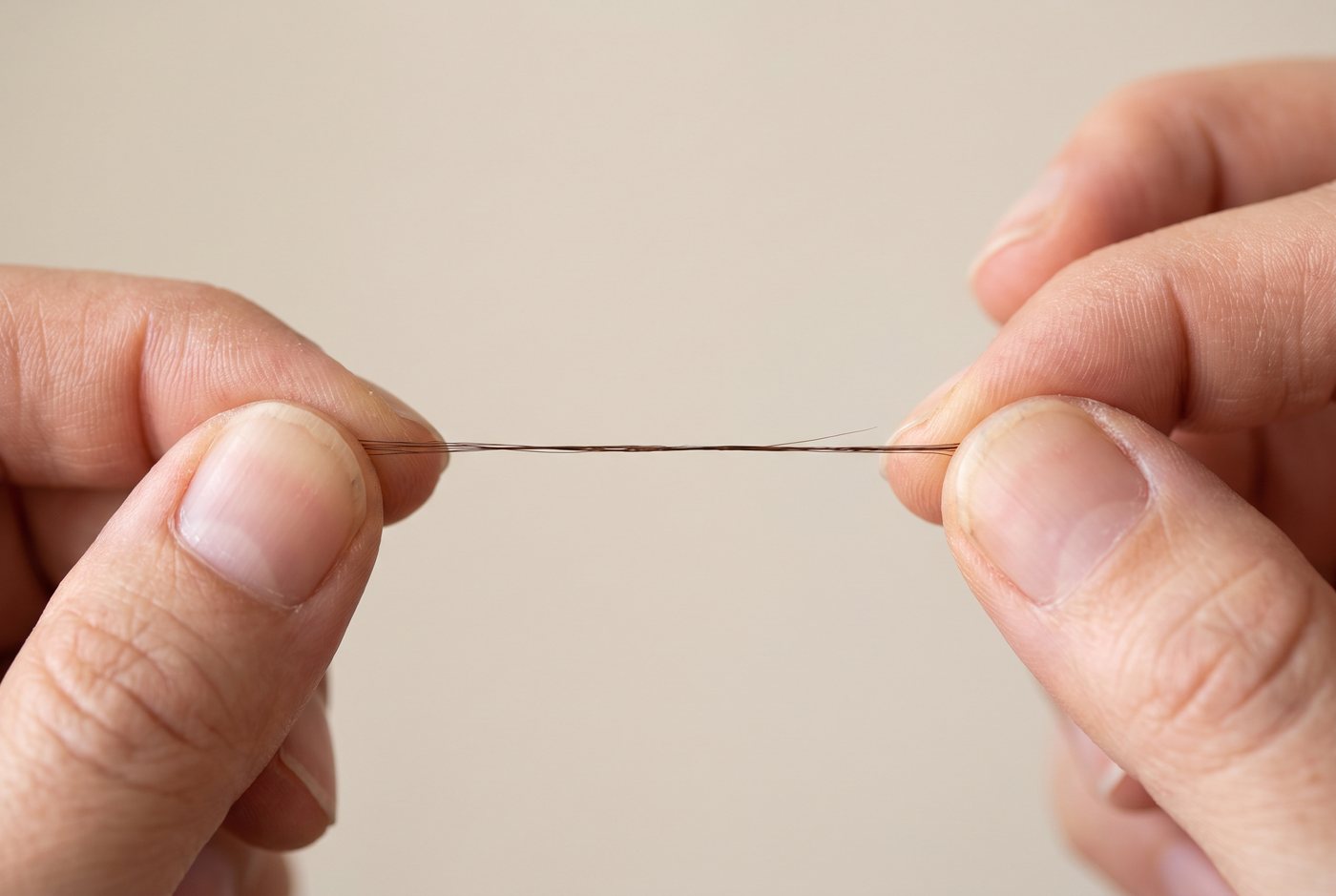
Pull one hair between your fingers. It should stretch before it breaks.
Take a single hair out of your brush. Hold it between the thumb and finger of each hand, about an inch apart, and pull it slowly.
A strand that was built properly has give in it. It stretches, visibly, and springs back when you let go. Hair is one of the strongest fibres your body makes, and that elasticity is where the strength actually lives.
A strand that snaps straight away, with no stretch at all, has none of that left.
This is the only check on the list that is not about how your hair looks. It is about how much it can take before it gives. Which is the thing that decides everything, because every single day that hair gets brushed, tied, wrapped, slept on and dragged through the neck of a jumper.
A strand with give survives all of that. A strand without it does not.
Short on time?
See what actually fixes this →The hairs in your brush are short
Go and look at your brush.
Most women glance at the amount and feel a small drop in their stomach. That is shedding, they think. That is my hair falling out.
Sometimes it is. But there is a way to tell, and it takes about four seconds.
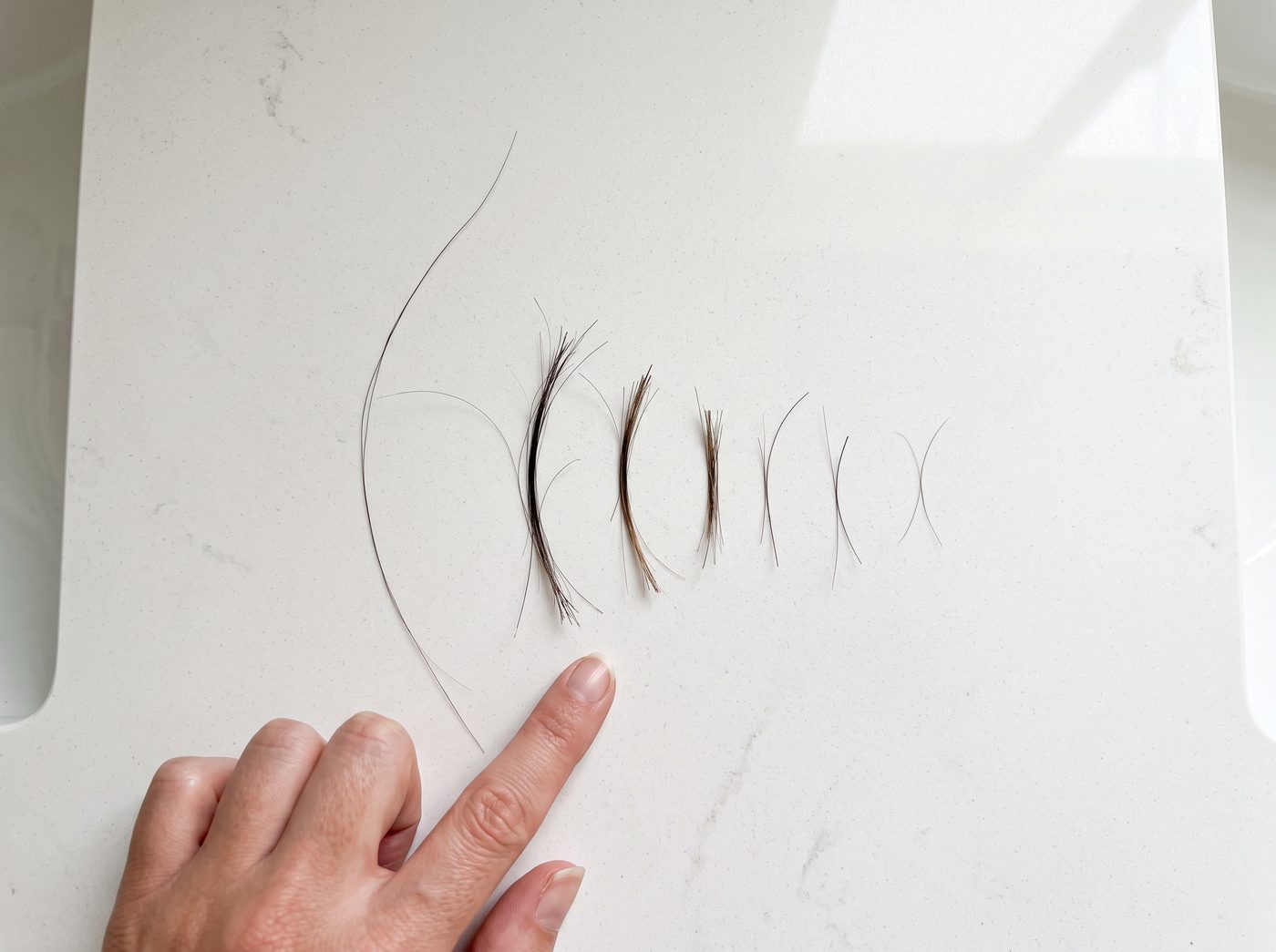
A hair that shed naturally is the full length of your hair, and it has a tiny pale bulb on the root end, because it reached the end of its life cycle and let go. That is normal. Everyone loses some every day.
A hair that broke is short, and it has no bulb. Just a blunt or frayed end where it gave way.
Pull a few out of your brush and lay them side by side on the counter. If they are all different lengths and most of them are shorter than your hair actually is, you are not watching your hair fall out.
You are watching it come apart.
Two-inch hairs on your shirt and your pillow
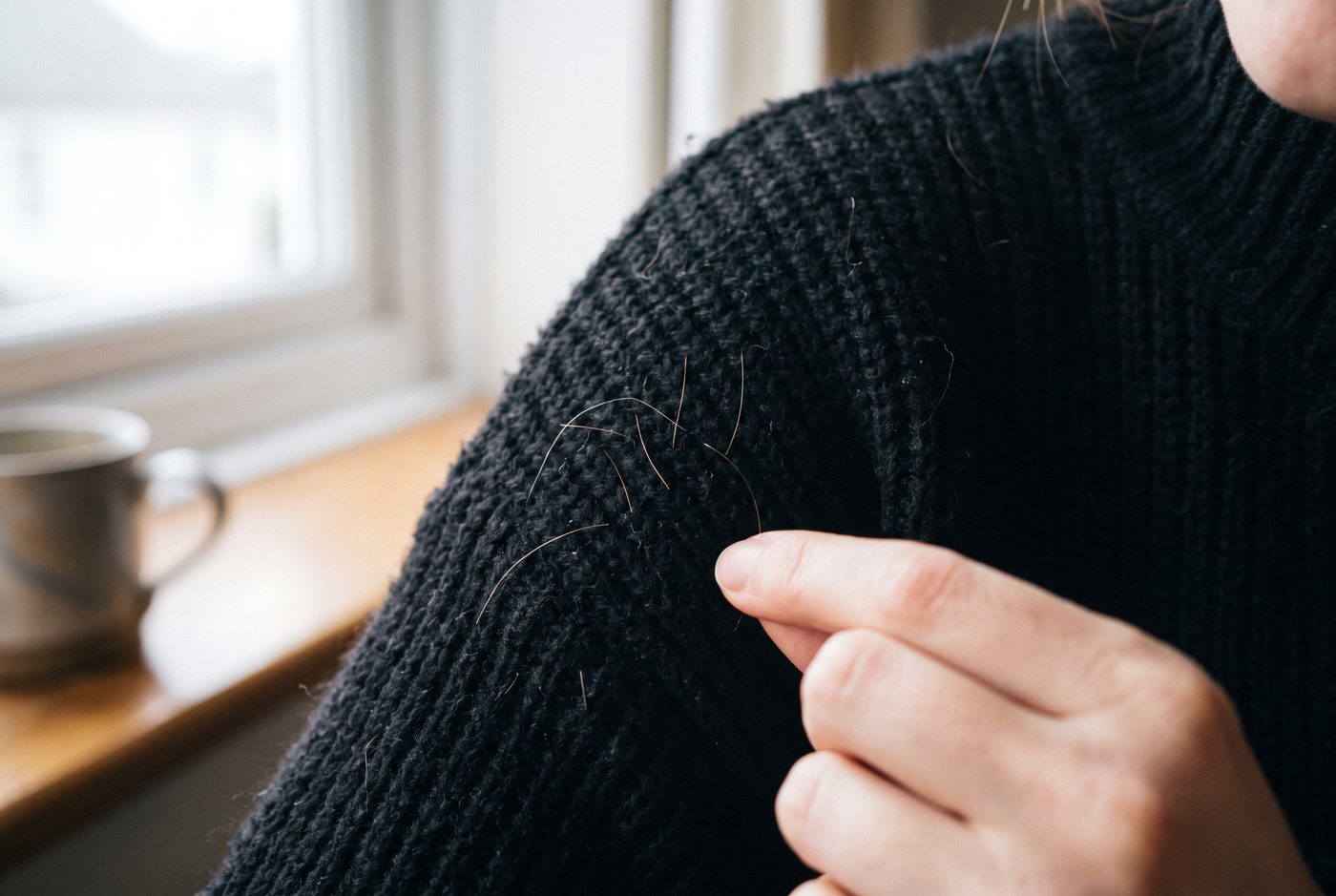
You have seen these a thousand times. You brush them off your shoulder without thinking.
But here is the thing that stops women when they hear it: almost nothing on your head is two inches long.
A few of them will be new growth, and that is normal. New growth has a soft, tapered tip, because it has never been cut or broken. So look at the ends. If they are blunt or frayed rather than tapered, they are not new hairs at all. Each one is a piece of a hair, and the rest of it is still attached to your head, ending in a blunt tip you have been calling a split end.
Once you notice this, you cannot unnotice it.
It snaps when you take your hair tie out
Not tugs. Not pulls. Snaps.
You have been running the test from sign three every single night without meaning to.
That small crackling sound when you pull the elastic out at the end of the day is so ordinary that most women have never once questioned it. It happens to everyone, so it must be normal.
It is common. It is not normal.
A well-built strand stretches and comes back. Hair is remarkably elastic when it has been built properly, which is why you can pull a healthy hair between two fingers and watch it give a little and then recover.
A strand that snaps instead of stretching has run out of that give. And if you can hear it happening, it is happening a lot.

It has been the same length in every photo for three years
Open your camera roll and scroll back.
Not to last month. Go back three years, then two, then one, then look at yourself now. For most women reading this, the length barely moves.
The obvious conclusion is the one almost everyone reaches: this is my limit. This is just how long my hair gets. Some people can grow it, and I am not one of them.
Now do the arithmetic.
Scalp hair grows around half an inch a month on average. That is six inches a year. Across those three years, you grew roughly eighteen inches of hair.
Some of that was always going to go, and it is worth being straight about that. Every follicle runs on a cycle. It grows for a few years, rests, sheds, and starts again. So a steady amount of shedding is normal, and every head of hair has a length where growth and shedding balance out.
But for most women that balance point sits well past the shoulders. If your length has not moved in three years and it is nowhere near there, normal shedding is not what is holding you.
Eighteen inches grew. You are not wearing them. Something took them off on the way.

So which one are you?
Count how many of the seven you recognised.
A score in this range usually points to breakage rather than growth rate. Which is honestly the better result, because it is the half of this you can do something about.
Some of both. This is what most women score, and it is the most commonly misread result there is.
Then it may genuinely be growth rate for you. Which is worth understanding, because what governs how fast a strand grows turns out to be the same thing that governs how strong it comes out.
Which brings us to the part that actually matters.
Slow growth and breakage are not two problems
Here is where most articles about hair send you off in one of two directions. You are either a slow grower or you are a breaker, and there is a different aisle of the shop for each.
That split has never really made sense, and here is why.
A follicle is a small factory. It builds a strand continuously, out of a fixed set of raw materials that arrive through your bloodstream. Protein for the structure. Minerals to cross-link and harden it. Vitamins that let the follicle actually use them. Collagen in the tissue around it.
When those materials run short, two things happen at the same time.
It builds slower, because a factory can only assemble what has arrived.
And it builds weaker, because the stretch of strand made during the shortage has a thin spot in it. Not visible. Not something you would ever feel. Just a place where the rope is narrower than the rest of the rope.

And a rope does not fail along its whole length. It fails at its thinnest point.
So slow growth and breakage are not two problems with two answers. They are two symptoms of the same shortage, and they almost always show up together. Which is why "am I a slow grower or am I breaking?" was always a slightly wrong question.
The useful question is what your hair is being built out of.
Why nothing you put on it can fix this
Here is the part that changes how you think about your bathroom shelf.
A strand of hair is built once. Everything that determines how strong it is, how far it will get, and whether it snaps at your shoulders happens inside the follicle, before the hair ever emerges. By the time you can see it, touch it, wash it or condition it, it is finished tissue. It is not alive and it cannot be rebuilt.
Masks, oils and bond repair products are not useless. They coat, they smooth, they reduce friction, and they genuinely make hair behave better in the short term. But they are working on the outside of something that failed on the inside, months ago.
You have been conditioning a strand that was finished eleven weeks before you bought the conditioner.
The only stage where anything can change is at the factory. And a follicle is fed by one thing only. Your bloodstream.
What that means in practice
Which is the thinking behind EVURA. Not a treatment, not a serum. Fifteen nutrients a follicle draws on to build a strand, delivered together, every day, so nothing is running short on the day this week's inch is being made.
Fifteen rather than one because a strand is only as strong as whatever it was shortest on. Megadosing a single vitamin does not thicken the rope. Biotin is in there, as it should be, but biotin alone at a very large dose is the reason so many women have a story that ends with "it did nothing."
No weak link. That is the entire idea.
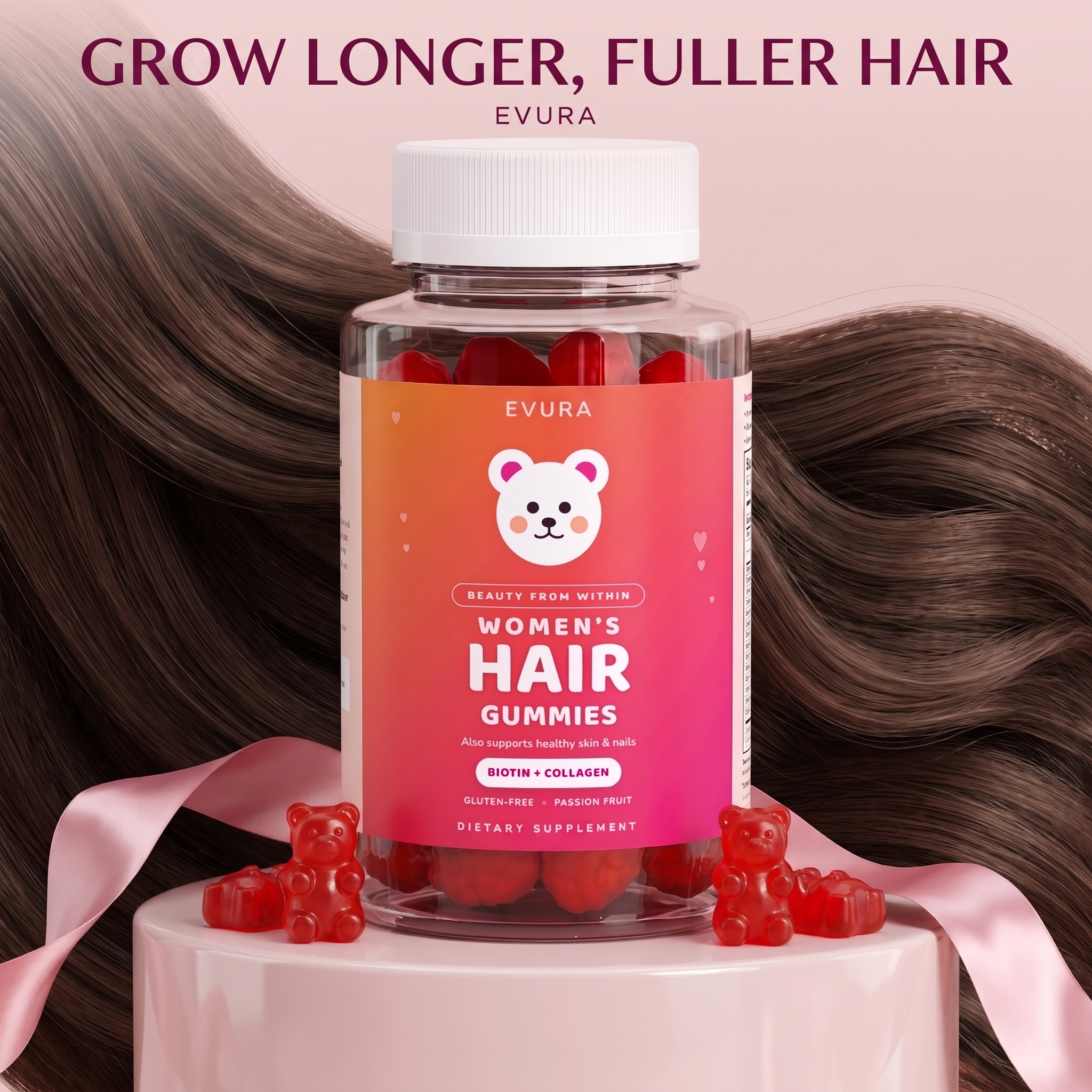
Fifteen nutrients. Two gummies a day.
See what is inside →What actually happens, and when
Here is the honest version, because you have been promised things before.
Ninety days is one hair cycle. It is the shortest honest test there is.
See the 90-day plan →Nails first, around week three. Length by day ninety.

The reason we say ninety days rather than thirty is not a sales tactic. It is that the hair you would inspect on day thirty left your scalp before you opened the jar. There is no version of this where a month is a fair test.
And if it does not work
Ninety days, and if your hair is no different, you get your money back. Finish the ninety days, email us, and we refund the purchase. There is no jar to send back.
It is a straightforward offer to make, because it is the same ninety days it takes to find out either way.
Your split ends were never just a trim reminder.
They were the only visible part of something happening where you cannot see it, and they have been telling you the same seven things for years.
The trim was only ever the first one.

Stop losing the length you are already growing.
Fifteen nutrients, two gummies a day, and ninety days to find out.
Start your 90 days →90-day money-back guarantee · free shipping on bundles
